Sideoats Grama
Bouteloua curtipendula
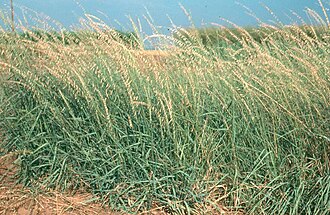
Sideoats grama is named for the way it flowers: two dozen or so small seed spikes dangle along one side of a slender arching stem, all in a row, like tiny oat panicles pinned to a wire. Close up the anthers are bright orange and red, unexpected on a grass and worth crouching for during the few weeks they show. It is the most widely distributed grama on the continent, native to more than forty states, and it bridges the shortgrass and tallgrass worlds — deep-rooted enough for drought, tolerant enough of clay and part shade to hold its own in a garden bed. It is a warm-season bunchgrass that also creeps a little by short rhizomes, filling in without taking over, which is why it appears in nearly every prairie seed mix. Skipper caterpillars feed on the foliage, and sparrows and juncos work the seed through winter. Its seed has documented food use.
- Family
- Poaceae
- Type
- grass
- Lifespan
- perennial
- Height
- 1.5–2.5 ft
- Spacing
- 1.5–2 ft apart
- Light
- sun, part shade
- Soil moisture
- dry
- Soil pH
- acidic, neutral, alkaline
- Bloom
- June, July, August, September, October, November
- Bloom colors
- red, orange, yellow
- Wildlife value
- songbirds, butterflies, larval host
- Landscape uses
- border, erosion control, naturalizing
- Native states
- AL, AR, AZ, CA, CO, CT, DC, FL, GA, IA, ID, IL, IN, KS, KY, LA, MD, MI, MN, MO, MS, MT, NC, ND, NE, NJ, NM, NV, NY, OH, OK, OR, PA, SC, SD, TN, TX, UT, VA, WA, WI, WV, WY
Related native plants
More Bouteloua species
- Blue Grama (Bouteloua gracilis)
- Buffalograss (Bouteloua dactyloides)
- Hairy Grama (Bouteloua hirsuta)
- Black Grama (Bouteloua eriopoda)
- Chino Grama (Bouteloua ramosa)