American Beautyberry
Callicarpa americana
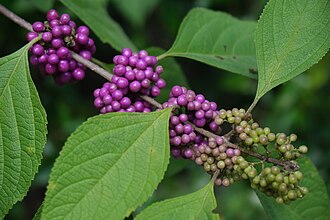
Nothing in the fall landscape reads like beautyberry: tight clusters of glossy magenta fruit ring the stems at every leaf node and hold on well after the leaves drop. The small flowers that precede them in summer are easy to overlook but bring in bees steadily. The fruit hangs late and works as a reserve food rather than a first choice, stripped by mockingbirds, catbirds and thrashers in hard weather once better fare is gone. Crushed leaves have a long folk history as a mosquito repellent, rubbed on skin or tucked under horse harness, and USDA chemists later isolated the compound behind it. The fruit is edible raw, juicy and faintly aromatic, and is more often cooked down into a folk jelly. Cut it hard in late winter — it flowers and fruits on new wood, and an untrimmed plant goes rangy.
- Family
- Lamiaceae
- Type
- shrub
- Lifespan
- perennial
- Height
- 3–6 ft
- Spacing
- 3–6 ft apart
- Light
- part shade
- Soil moisture
- moist
- Soil pH
- acidic, neutral
- Bloom
- May, June, July
- Bloom colors
- white, pink
- Wildlife value
- songbirds, butterflies, pollinators
- Landscape uses
- border, naturalizing, rain garden
- Native states
- AL, AR, FL, GA, KY, LA, MD, MO, MS, NC, OK, SC, TN, TX, VA