New Jersey Tea
Ceanothus americanus
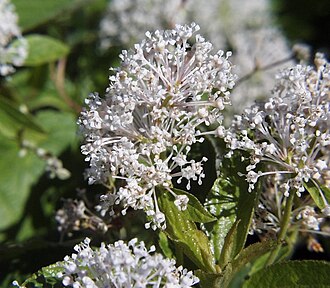
New Jersey tea sends up frothy domes of tiny white flowers in midsummer over a low, tidy mound, and the bloom is one of the busiest insect events of the season — small bees, wasps, beetles and butterflies work it constantly. It fixes its own nitrogen through root nodules and drives a deep, woody taproot that makes it exceptionally drought-hardy and, past the first year or two, essentially impossible to move. That taproot is also why it survives prairie fire and why it belongs in a bed you do not intend to rework. It is the larval host for the mottled duskywing and the summer azure. The dried leaves brew a refreshing, caffeine-free tea that was used as a substitute for imported china tea during the Revolutionary War, which is where the name comes from. Give it sun and sharp drainage; it will not forgive heavy wet soil.
- Family
- Rhamnaceae
- Type
- shrub
- Lifespan
- perennial
- Height
- 3–4 ft
- Spacing
- 3–5 ft apart
- Light
- sun, part shade
- Soil moisture
- dry, moist
- Soil pH
- acidic, neutral
- Bloom
- March, April, May, June, July, August
- Bloom colors
- white
- Wildlife value
- songbirds, butterflies, larval host, pollinators
- Caterpillar hosts
- ~45 butterfly & moth species
- Landscape uses
- foundation, naturalizing, rain garden
- Native states
- AL, AR, CT, DC, DE, FL, GA, IA, IL, IN, KS, KY, LA, MA, MD, ME, MI, MN, MO, MS, NC, NE, NH, NJ, NY, OH, OK, PA, RI, SC, TN, TX, VA, VT, WI, WV
Related native plants
More Ceanothus species
- Buckbrush (Ceanothus cuneatus)
- Snowbrush (Ceanothus velutinus)
- Blueblossom (Ceanothus thyrsiflorus)
- Chaparral Whitethorn (Ceanothus leucodermis)
- Deerbrush (Ceanothus integerrimus)
- Mountain Whitethorn (Ceanothus cordulatus)