American Bittersweet
Celastrus scandens
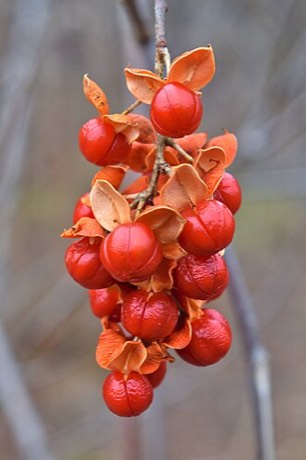
The native bittersweet — not the invasive Oriental C. orbiculatus that displaces it. Yellow capsules split to reveal orange-red arils; female plants only fruit if a male is nearby. The fruit is poisonous and all parts are potentially toxic — cut it for wreaths, not for eating.
- Family
- Celastraceae
- Type
- vine
- Lifespan
- perennial
- Height
- 15–20 ft
- Spacing
- 3–6 ft apart
- Light
- sun, part shade, shade
- Soil moisture
- dry, moist
- Soil pH
- acidic, neutral
- Bloom
- May, June
- Bloom colors
- yellow, green, brown
- Wildlife value
- songbirds
- Landscape uses
- hedge or screen, naturalizing
- Native states
- AL, AR, CT, DC, DE, GA, IA, IL, IN, KS, KY, LA, MA, MD, ME, MI, MN, MO, MS, MT, NC, ND, NE, NH, NJ, NY, OH, OK, PA, RI, SC, SD, TN, TX, VA, VT, WI, WV, WY