Silky Dogwood
Cornus amomum
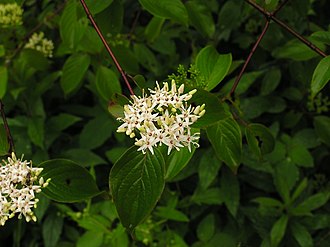
Silky dogwood is the wetland member of the genus, holding streambanks and pond edges where its shallow roots do as much good as its top growth. The porcelain-blue fruit is the identifying character — no other native dogwood fruits that color, and it ripens in late summer, a season behind the flat white flower clusters. Young stems are a dull reddish purple rather than the bright red of redosier, and the leaf undersides carry the silky hairs that give the plant its name. It suckers to form dense thickets, which is exactly what a raw bank needs and exactly wrong for a small bed. The fruit is edible raw or cooked and is said to be very good, though birds rarely leave enough to test the claim. It is a heavily used caterpillar host, and the flowers feed a wide range of small native bees.
- Family
- Cornaceae
- Type
- shrub
- Lifespan
- perennial
- Height
- 6–12 ft
- Spacing
- 6–12 ft apart
- Light
- part shade, shade
- Soil moisture
- moist
- Soil pH
- acidic, neutral
- Bloom
- March, April
- Bloom colors
- white
- Wildlife value
- butterflies, pollinators, mammals, songbirds, larval host
- Caterpillar hosts
- ~118 butterfly & moth species
- Landscape uses
- naturalizing, rain garden
- Native states
- AL, CT, DC, DE, FL, GA, IA, IL, IN, KY, MA, MD, ME, MI, MO, MS, NC, NH, NJ, NY, OH, PA, RI, SC, TN, VA, VT, WI, WV
Related native plants
More Cornus species
- Flowering Dogwood (Cornus florida)
- Bunchberry (Cornus canadensis)
- Red Osier Dogwood (Cornus sericea)
- Roughleaf Dogwood (Cornus drummondii)
- Pagoda Dogwood (Cornus alternifolia)
- Pacific Dogwood (Cornus nuttallii)