American Hazelnut
Corylus americana
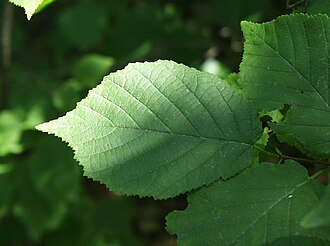
American hazelnut carries the earliest catkins in the eastern spring, dangling and shedding pollen in March while the minute female flowers open separately on the same shrub as tufts of thread-like stigmas barely a few millimeters across, easy to miss entirely. The nuts sit in ragged, deeply fringed husks and ripen in late summer, sweet and thick-shelled, smaller than a commercial filbert but of the same quality — squirrels and jays take nearly all of them unless you get there first at the milk stage. It suckers into thickets, which makes it a useful hedgerow and screening plant and a difficult one to keep as a tidy single specimen. It fruits best in sun but tolerates real shade, and it feeds a long list of native caterpillars. Unlike its European relative it is largely resistant to eastern filbert blight, and it is being bred as a hardy nut crop for that reason.
- Family
- Betulaceae
- Type
- shrub
- Lifespan
- perennial
- Height
- 10–16 ft
- Spacing
- 8–13 ft apart
- Light
- part shade, shade
- Soil moisture
- dry, moist
- Soil pH
- acidic, neutral
- Bloom
- April, May, June
- Bloom colors
- white, green
- Wildlife value
- butterflies, mammals, songbirds, larval host
- Caterpillar hosts
- ~131 butterfly & moth species
- Landscape uses
- border, hedge or screen, naturalizing
- Native states
- AL, AR, CT, DC, DE, GA, IA, IL, IN, KS, KY, LA, MA, MD, ME, MI, MN, MO, MS, NC, ND, NE, NH, NJ, NY, OH, OK, PA, RI, SC, SD, TN, VA, VT, WI, WV