Pale Purple Coneflower
Echinacea pallida
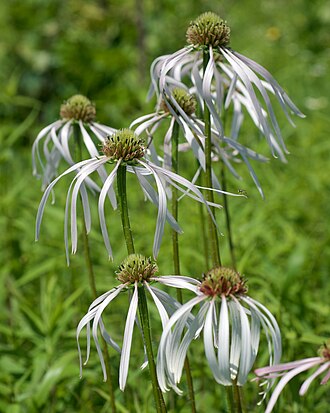
Pale purple coneflower is the narrowest and most sharply reflexed of the coneflowers: thin pink rays hang almost straight down from a coppery cone, so a stand reads as a scatter of drooping ribbons rather than a bed of daisies. It flowers a month ahead of purple coneflower and barely overlaps with it, which makes the two worth planting together. A taproot two to three feet deep is what carries it through drought and also what makes it nearly impossible to divide or move, so start it from seed where it is to grow. The seed heads are stiff enough to stand all winter and goldfinches work them hard, so resist deadheading. It wants full sun and lean, well-drained ground; in rich soil it flops and is short-lived. Do not read the sparse, hanging rays as a plant in poor condition — that is simply its shape.
- Family
- Asteraceae
- Type
- wildflower
- Lifespan
- perennial
- Height
- 2–3 ft
- Spacing
- 1–1.5 ft apart
- Light
- sun
- Soil moisture
- dry, moist
- Soil pH
- neutral
- Bloom
- May, June, July
- Bloom colors
- pink, purple
- Wildlife value
- pollinators, butterflies, hummingbirds
- Landscape uses
- border, naturalizing
- Native states
- AL, AR, GA, IA, IL, IN, KS, LA, MO, NC, NE, OK, TN, TX, WI
Related native plants
More Echinacea species
- Purple Coneflower (Echinacea purpurea)
- Narrowleaf Coneflower (Echinacea angustifolia)
- Tennessee Coneflower (Echinacea tennesseensis)
- Sanguine Coneflower (Echinacea sanguinea)
- Yellow Coneflower (Echinacea paradoxa)