Bottlebrush Grass
Elymus hystrix
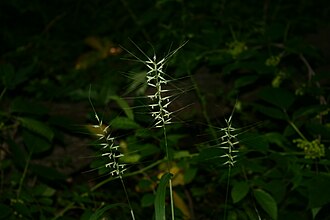
Bottlebrush grass has the most distinctive seed head of any eastern grass: the spikelets stick out almost perpendicular to the stem in a bristling cylinder, so the whole thing reads as a bottlebrush or a green sparkler held above the foliage. It is cool-season, greening up in early spring and flowering in early summer while the warm-season prairie grasses are still short, then going dormant and straw-colored through the hottest weeks. That schedule is what makes it one of the very few native grasses genuinely good in woodland shade, where it grows in open oak and beech understory. The seed heads dry pale and hold their shape for months, and they cut well. It is a clump-former that never runs but self-sows freely, so it moves around a planting rather than staying where it was put. Skipper and satyr caterpillars feed on the foliage.
- Family
- Poaceae
- Type
- grass
- Lifespan
- perennial
- Height
- 2.5–3 ft
- Spacing
- 1–1.5 ft apart
- Light
- sun, part shade
- Soil moisture
- dry, moist
- Soil pH
- acidic, neutral, alkaline
- Bloom
- June, July, August
- Bloom colors
- green
- Wildlife value
- butterflies, larval host
- Landscape uses
- specimen, border, naturalizing
- Native states
- AL, AR, CT, DC, DE, GA, IA, IL, IN, KS, KY, MA, MD, ME, MI, MN, MO, NC, ND, NE, NH, NJ, NM, NY, OH, OK, PA, RI, SC, SD, TN, VA, VT, WI, WV
Related native plants
More Elymus species
- Virginia Wild Rye (Elymus virginicus)
- Canada Wild Rye (Elymus canadensis)
- Blue Wildrye (Elymus glaucus)
- Hairy Wild Rye (Elymus villosus)
- Slender Wheatgrass (Elymus trachycaulus)
- Thickspike Wheatgrass (Elymus lanceolatus)