Queen-of-the-Prairie
Filipendula rubra
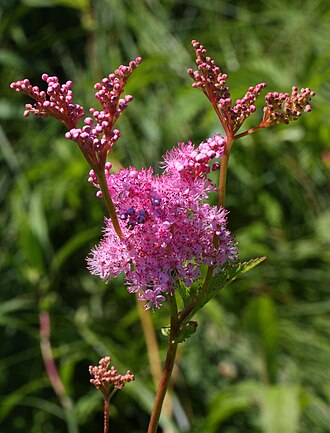
Queen-of-the-prairie carries huge branched plumes of tiny pink flowers on stems six to eight feet tall, and at a distance the effect really is like drifting cotton candy — there is nothing subtle about this plant. Its leaves are large and jaggedly cut, more like a garden aruncus than a prairie forb, and they hold well as long as the roots stay wet. It is a wet-meadow and fen plant and it means it: in a dry spell the whole plant wilts dramatically and the leaf margins scorch, and it will not recover its looks that season. It spreads by rhizome into a colony where it is happy, the right behavior for a naturalized wet area and the wrong one for a small bed. The flowers offer no nectar and are worked by bees and beetles for pollen alone. It is rare across much of its range, and most garden stock traces to a handful of collections.
- Family
- Rosaceae
- Type
- wildflower
- Lifespan
- perennial
- Height
- 6–8 ft
- Spacing
- 3–4 ft apart
- Light
- part shade
- Soil moisture
- moist
- Soil pH
- acidic, neutral, alkaline
- Bloom
- June, July, August
- Bloom colors
- pink
- Wildlife value
- pollinators, butterflies
- Landscape uses
- erosion control, naturalizing
- Native states
- IA, IL, IN, KS, MA, MD, MI, MO, NC, NJ, OH, PA, VA, WI, WV, WY