Soft Rush
Juncus effusus
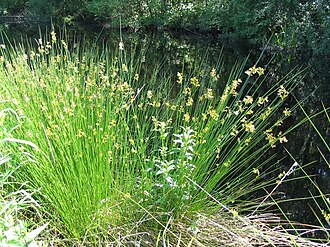
Also known as: Common Rush
Soft rush is neither a grass nor a sedge but a rush, and the giveaway is the stem: smooth, round in cross-section, unjointed, and green the whole way up with no obvious leaves at all. It grows as a dense fountain of those stems, and the flowers emerge as a loose tan cluster from the side near the tip rather than at the top, so a flowering stem looks bent past its own inflorescence. It is a foundation plant of pond margins, ditches and rain gardens, holding its form in standing water and in ground that merely stays damp, and its two-foot root system makes it a workhorse for stabilizing a bank. The pith inside the stem was drawn out whole, soaked in fat and burned as a rushlight, the cheapest household lighting in pre-industrial Britain. Split stems are still woven for tatami facing and fine basketry in Japan. Sparrows and waterfowl take the seed, and the clumps give cover to frogs and nesting marsh birds.
- Family
- Juncaceae
- Type
- grass
- Lifespan
- perennial
- Height
- 2–4 ft
- Spacing
- 2–4 ft apart
- Light
- sun
- Soil moisture
- moist
- Soil pH
- acidic, neutral, alkaline
- Bloom
- July, August, September
- Bloom colors
- green, brown
- Wildlife value
- songbirds
- Landscape uses
- specimen, border, naturalizing
- Native states
- AL, AR, AZ, CA, CO, CT, DC, DE, FL, GA, IA, IL, IN, KS, KY, LA, MA, MD, ME, MI, MN, MO, MS, NC, NH, NJ, NY, OH, OK, OR, PA, RI, SC, TN, TX, VA, VT, WA, WI, WV