Northern Spicebush
Lindera benzoin
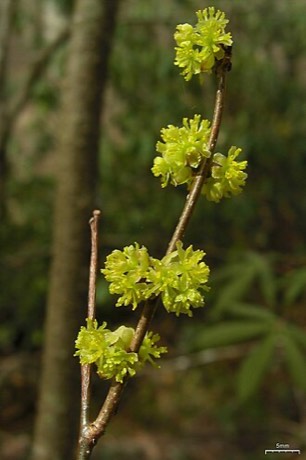
Spicebush is the shrub layer of a healthy eastern woodland: it flowers as a haze of tiny yellow blossoms on bare stems in earliest spring, then holds clean foliage all season in shade deep enough to defeat most shrubs. Every part is aromatic when crushed, which is the fastest way to name it in winter with no leaves to go on. It is the host plant for the spicebush swallowtail, whose caterpillar folds itself into a leaf and wears two large false eyespots. Plants are male or female, so fruit needs both nearby; the scarlet drupes are unusually high in fat and are prime fuel for migrating thrushes and vireos. Deer pass it by, so it often thickens in woods where browsing has stripped out everything else. Young leaves, twigs and fruit make a very fragrant tea, and the dried, powdered fruit substitutes for allspice.
- Family
- Lauraceae
- Type
- tree
- Lifespan
- perennial
- Height
- 6–12 ft
- Spacing
- 6–12 ft apart
- Light
- sun, part shade, shade
- Soil moisture
- dry, moist
- Soil pH
- acidic
- Bloom
- March, April, May
- Bloom colors
- white, yellow
- Wildlife value
- songbirds, butterflies, larval host
- Caterpillar hosts
- ~11 butterfly & moth species
- Landscape uses
- rain garden
- Native states
- AL, AR, CT, DC, DE, FL, GA, IA, IL, IN, KS, KY, LA, MA, MD, ME, MI, MO, MS, NC, NH, NJ, NY, OH, OK, PA, RI, SC, TN, TX, VA, VT, WV