Tulip Poplar
Liriodendron tulipifera
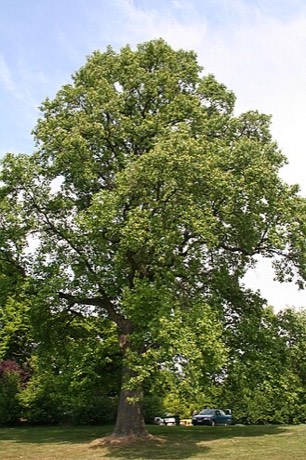
Also known as: Yellow Poplar, Tuliptree
The tallest hardwood in eastern North America, tulip poplar runs straight and branch-free for fifty feet or more before the crown begins, which is why it was the tree of choice for dugout canoes. Its cup-shaped green and yellow flowers are large but sit so high in the canopy that most people meet them first as fallen petals on the ground; they are a heavy nectar flow, and the honey from them is a distinct dark grade. The leaf is unmistakable, squared off at the tip as though the end had been snipped away, and it turns clear yellow in fall. Growth is fast and the wood is brittle, so give it room away from the house and expect limb drop in ice. It is the larval host of the tiger swallowtail. The root has a lemony flavor and was once used in spruce beer, where it also corrected the beer's bitterness.
- Family
- Magnoliaceae
- Type
- tree
- Lifespan
- perennial
- Height
- 60–90 ft
- Spacing
- 30–50 ft apart
- Light
- sun, part shade, shade
- Soil moisture
- moist
- Soil pH
- acidic, neutral
- Bloom
- April, May, June
- Bloom colors
- yellow, green, brown
- Wildlife value
- songbirds, butterflies, hummingbirds, larval host
- Caterpillar hosts
- ~21 butterfly & moth species
- Landscape uses
- rain garden
- Native states
- AL, AR, CT, DC, DE, FL, GA, IL, IN, KY, LA, MA, MD, MI, MO, MS, NC, NJ, NY, OH, PA, RI, SC, TN, TX, VA, VT, WI, WV