Allegheny Monkeyflower
Mimulus ringens
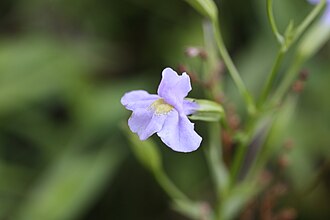
Also known as: Square-stemmed Monkeyflower
Allegheny monkeyflower holds pairs of two-lipped purple flowers in the leaf axils up a distinctly square stem — run a thumb along it and the four ridges are unmistakable. The lower lip carries pale nectar guides that steer bumblebees into the throat, and the stigma is touch-sensitive, folding shut within seconds of contact so that pollen just delivered is not scraped back off as the bee leaves. It wants ground that never dries: pond margins, ditches, wet meadows and rain gardens, where it will take standing water for weeks at a stretch. Bloom runs from midsummer into early fall, a long stretch for a wetland forb, and it self-sows freely into bare wet mud. It is a larval host for the common buckeye. Deer generally leave it alone.
- Family
- Phrymaceae
- Type
- wildflower
- Lifespan
- perennial
- Height
- 1–3 ft
- Spacing
- 0.75–1 ft apart
- Light
- sun
- Soil moisture
- moist, wet
- Soil pH
- acidic, neutral
- Bloom
- June, July, August, September
- Bloom colors
- red, pink, blue, purple
- Wildlife value
- butterflies, larval host
- Landscape uses
- border, naturalizing, rain garden
- Native states
- AL, AR, CA, CO, CT, DC, DE, GA, IA, ID, IL, IN, KS, KY, LA, MA, MD, ME, MI, MN, MO, MS, MT, NC, ND, NE, NH, NJ, NY, OH, OK, OR, PA, RI, SC, SD, TN, VA, VT, WA, WI, WV
Related native plants
More Mimulus species
- Sharpwing Monkeyflower (Mimulus alatus)
- Bigelow's Monkeyflower (Mimulus bigelovii)
- Lewis's Monkeyflower (Mimulus lewisii)
- Primrose Monkeyflower (Mimulus primuloides)
- Kellogg's Monkeyflower (Mimulus kelloggii)
- Yellow-and-white Monkeyflower (Mimulus bicolor)