Virginia Creeper
Parthenocissus quinquefolia
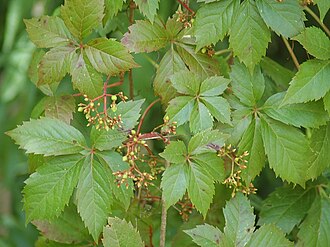
Virginia creeper climbs by tendrils tipped with adhesive pads that grip masonry without penetrating it, so unlike English ivy it does no structural damage — and its five leaflets tell it apart at a glance from poison ivy's three. Fall color is among the earliest and most intense of any native vine, a deep scarlet that can start in August. It grows in everything from full sun to deep shade, and it is a larval host for several sphinx moths, the Virginia creeper sphinx among them. Birds strip the dark blue berries through fall and lean on them heavily. Those berries are not a human food: they contain oxalate raphides, microscopic needle-like crystals, and there is evidence they are outright poisonous. Handling the autumn foliage causes dermatitis in some people.
- Family
- Vitaceae
- Type
- vine
- Lifespan
- perennial
- Height
- 30–50 ft
- Spacing
- 5–10 ft apart
- Light
- sun, part shade, shade
- Soil moisture
- moist
- Soil pH
- acidic, neutral
- Bloom
- May, June
- Bloom colors
- white, green
- Wildlife value
- songbirds, larval host
- Caterpillar hosts
- ~32 butterfly & moth species
- Landscape uses
- hedge or screen
- Native states
- AL, AR, CT, DC, DE, FL, GA, IA, IL, IN, KS, KY, LA, MA, MD, ME, MI, MN, MO, MS, NC, ND, NE, NH, NJ, NV, NY, OH, OK, PA, RI, SC, SD, TN, TX, VA, VT, WI, WV, WY