Large Beardtongue
Penstemon grandiflorus
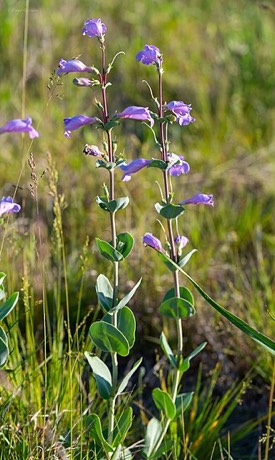
Large beardtongue carries the biggest flowers of any penstemon on the continent, inflated lavender bells up to two inches long ranged along smooth, waxy blue-green stems that look almost artificial. Everything about it is built for dry sand: the waxy bloom on the foliage cuts water loss, and the plant will rot outright in a rich, irrigated bed. Long-tongued bumblebees are the main visitor and are heavy enough to force the throat open; the sterile fifth stamen that gives beardtongues their name lies along the floor of the flower like a bristly tongue. It is short-lived, three or four years at most, but self-sows readily wherever the ground stays open, so let a few seed capsules stand and shatter. The basal rosettes hold through winter and are often the first green thing on a sandy prairie in March.
- Family
- Plantaginaceae
- Type
- wildflower
- Lifespan
- perennial
- Height
- 2–4 ft
- Spacing
- 1–1.5 ft apart
- Light
- sun
- Soil moisture
- dry, moist
- Soil pH
- neutral, alkaline
- Bloom
- May, June
- Bloom colors
- pink, purple
- Wildlife value
- pollinators, hummingbirds, butterflies, larval host
- Caterpillar hosts
- ~8 butterfly & moth species
- Landscape uses
- border
- Native states
- CO, IA, IL, KS, MA, MN, MO, MT, ND, NE, OH, OK, SD, TX, WI, WY
Related native plants
More Penstemon species
- Foxglove Beardtongue (Penstemon digitalis)
- Cobaea Beardtongue (Penstemon cobaea)
- Scarlet Bugler (Penstemon centranthifolius)
- Palmer's Penstemon (Penstemon palmeri)
- Beardlip Penstemon (Penstemon barbatus)
- Showy Penstemon (Penstemon spectabilis)