Summer Phlox
Phlox paniculata
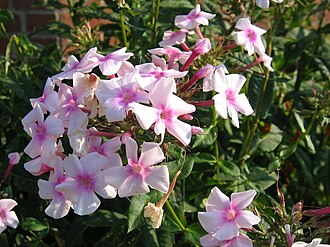
Also known as: Garden Phlox, Tall Phlox
Garden phlox is the backbone of the late-summer border, carrying large domed panicles of fragrant pink to purple flowers for six weeks when little else of that size is open. Each flower is a narrow tube with a flat face, too deep for most bees, so the visitors are butterflies, clearwing moths and hummingbirds — it is one of the best nectar plants a garden can hold for swallowtails. Powdery mildew is its one real fault and it is a siting problem before it is a spray problem: morning sun, air on all sides, and a third of the stems thinned out in spring will take care of most of it. Cultivars vary enormously in mildew resistance, and the volunteer seedlings that appear around a planting revert toward a washed magenta that will slowly take over a bed if allowed to stand. It wants steady moisture and drops its lower leaves in a dry spell. Cut stems last well and the scent carries across a room.
- Family
- Polemoniaceae
- Type
- wildflower
- Lifespan
- perennial
- Height
- 2–4 ft
- Spacing
- 2–3 ft apart
- Light
- sun
- Soil moisture
- moist
- Soil pH
- acidic, alkaline, neutral
- Bloom
- June, July, August
- Bloom colors
- pink, purple
- Wildlife value
- pollinators, butterflies, hummingbirds
- Landscape uses
- border
- Native states
- AL, AR, DC, GA, IL, IN, KS, KY, LA, MA, MD, MO, MS, NC, NE, NY, OH, OK, PA, TN, UT, VA, WA, WI, WV
Related native plants
More Phlox species
- Woodland Phlox (Phlox divaricata)
- Downy Phlox (Phlox pilosa)
- Longleaf Phlox (Phlox longifolia)
- Moss Phlox (Phlox subulata)
- Annual Phlox (Phlox drummondii)
- Spreading Phlox (Phlox diffusa)