American Sycamore
Platanus occidentalis
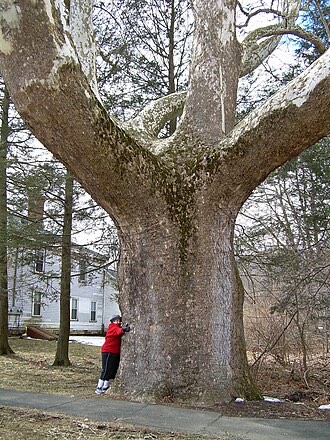
American sycamore is the most massive deciduous tree of eastern North America by trunk diameter, and it advertises the fact by shedding its outer bark in plates to leave the upper limbs a startling chalk white, visible across a winter floodplain from a mile off. It is a river tree first, tolerant of spring flooding and silt burial, and it grows fast enough to look established in a decade. Old trunks hollow readily, and those cavities are prime denning and roosting space for chimney swifts, wood ducks, raccoons and bats — a hollow sycamore is a piece of habitat in its own right. The round seed balls hang on all winter on long stalks and break apart in spring. The sweet sap can be tapped in spring and boiled down for syrup and sugar, much as maple is. In hot dry weather the fine hairs shed from its leaves and fruits can irritate the airways, causing a reaction much like hay fever.
- Family
- Platanaceae
- Type
- tree
- Lifespan
- perennial
- Height
- 75–100 ft
- Spacing
- 75–100 ft apart
- Light
- sun, part shade, shade
- Soil moisture
- moist, wet
- Soil pH
- acidic, neutral
- Bloom
- March, April
- Bloom colors
- red, yellow, green, brown
- Wildlife value
- songbirds, larval host
- Caterpillar hosts
- ~45 butterfly & moth species
- Landscape uses
- hedge or screen, rain garden
- Native states
- AL, AR, CT, DC, DE, FL, GA, IA, IL, IN, KS, KY, LA, MA, MD, ME, MI, MO, MS, NC, NE, NH, NJ, NY, OH, OK, PA, RI, SC, TN, TX, VA, VT, WI, WV