Rock Polypody
Polypodium virginianum
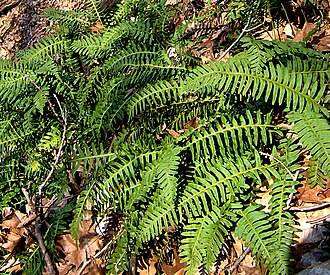
Also known as: Common Polypody
Rock polypody lives on rock: it colonizes the tops and shaded faces of mossy boulders, ledges and old stone walls, rooting in nothing more than a skin of moss and accumulated debris. Its rhizomes creep across that surface rather than down into soil, which is why a colony forms a flat green mat that can be peeled up like carpet. In drought the fronds curl inward and go dull and papery, looking dead, then rehydrate within hours of rain — a genuine resurrection habit that lets it live where no soil-rooted fern could. The fronds are simple and leathery, cut once into blunt lobes, and they stay green all winter under snow. Round sori sit in a neat row either side of the midrib on the underside, easy to see and diagnostic. It wants shade, acidic rock and moving air, and it resists transplanting into an ordinary garden bed.
- Family
- Polypodiaceae
- Type
- fern
- Lifespan
- perennial
- Height
- 0.5–1 ft
- Spacing
- 0.5–1 ft apart
- Light
- part shade, shade
- Soil moisture
- dry
- Soil pH
- acidic, neutral
- Wildlife value
- mammals, songbirds
- Landscape uses
- border
- Native states
- AL, AR, CT, DC, DE, GA, IA, IL, IN, KY, MA, MD, ME, MI, MN, MO, NC, NH, NJ, NY, OH, PA, RI, SC, SD, TN, VA, VT, WI, WV
Related native plants
More Polypodium species
- Licorice Fern (Polypodium glycyrrhiza)
- California Polypody (Polypodium californicum)
- Leathery Polypody (Polypodium scouleri)