American Plum
Prunus americana
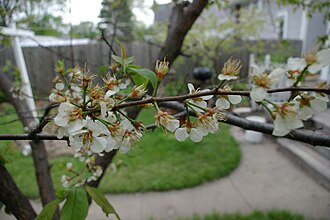
Thicket-forming wild plum that clouds the early-spring prairie edge in fragrant white bloom, then bears tart red fruit for jelly and wildlife. Suckers into protective hedgerows. As with every plum and cherry, the flesh is the food: the pits, leaves and twigs are cyanogenic and are not.
- Family
- Rosaceae
- Type
- tree
- Lifespan
- perennial
- Height
- 15–25 ft
- Spacing
- 15–25 ft apart
- Light
- sun, part shade, shade
- Soil moisture
- moist
- Soil pH
- acidic, neutral
- Bloom
- April, May, June
- Bloom colors
- white
- Wildlife value
- pollinators, butterflies, mammals, songbirds, larval host
- Caterpillar hosts
- ~456 butterfly & moth species
- Landscape uses
- specimen, hedge or screen
- Native states
- AL, AR, AZ, CO, CT, DC, DE, FL, GA, IA, ID, IL, IN, KS, KY, LA, MA, MD, MI, MN, MO, MS, MT, NC, ND, NE, NJ, NM, NY, OH, OK, OR, PA, RI, SC, SD, TN, UT, VA, VT, WA, WI, WV, WY
Related native plants
More Prunus species
- Black Cherry (Prunus serotina)
- Chokecherry (Prunus virginiana)
- Carolina Laurelcherry (Prunus caroliniana)
- Hollyleaf Cherry (Prunus ilicifolia)
- Mexican Plum (Prunus mexicana)
- Beach Plum (Prunus maritima)