Chinkapin Oak
Quercus muehlenbergii
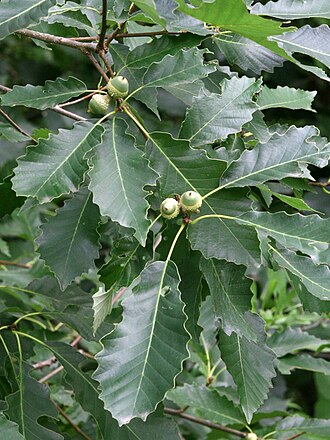
Chinkapin oak is the oak for thin alkaline ground, growing out of limestone bluffs and old quarry edges where most oaks sulk, and it is one of the few that actively prefers a high pH. Its leaves look far more like chestnut than oak, narrow and edged with big even teeth, each tooth tipped with a small point rather than a bristle. The acorns carry very little tannin and are sweet enough to eat baked with no leaching at all, which is why deer, turkey and jays clear them within days of the drop. Like the white oaks generally it supports an enormous number of native caterpillar species, making it one of the most productive bird-feeding trees a property can hold. Its bark is thin, light gray and flaky, quite unlike the deep ridges of most large oaks. It is drought-hardy once established but resents wet feet.
- Family
- Fagaceae
- Type
- tree
- Lifespan
- perennial
- Height
- 40–60 ft
- Spacing
- 50–70 ft apart
- Light
- sun, part shade
- Soil moisture
- dry
- Soil pH
- acidic, neutral, alkaline
- Bloom
- March, April, May
- Bloom colors
- yellow, green, brown
- Wildlife value
- songbirds, butterflies, hummingbirds, larval host
- Caterpillar hosts
- ~557 butterfly & moth species
- Landscape uses
- naturalizing
- Native states
- AL, AR, CT, DC, DE, FL, GA, IA, IL, IN, KS, KY, LA, MA, MD, MI, MN, MO, MS, NC, NE, NJ, NM, NY, OH, OK, PA, SC, TN, TX, VA, VT, WI, WV
Related native plants
More Quercus species
- Pin Oak (Quercus palustris)
- Northern Red Oak (Quercus rubra)
- White Oak (Quercus alba)
- Coast Live Oak (Quercus agrifolia)
- Willow Oak (Quercus phellos)
- Bur Oak (Quercus macrocarpa)