Skunkbush Sumac
Rhus trilobata
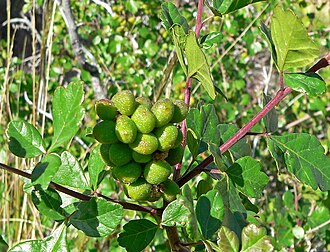
Skunkbush sumac is the western dryland sumac, a dense mounding shrub of three-lobed leaflets that release a sharp, resinous smell when crushed — pleasant or not depending on the nose. It is exceptionally drought- and cold-hardy, roots deeply, and suckers to hold banks, road cuts and windbreaks in ground where little else will establish. Fuzzy red fruit ripens in summer and hangs into fall, feeding quail, grouse and songbirds through the lean months. Soaked ten to thirty minutes in cool water the fruit makes a refreshing lemonade-like drink; it should not be boiled, which pulls tannins and turns it astringent. The fruit is also dried, mixed with cornmeal or made into jam. Its split stems were a staple basketry material across the Southwest and Great Basin, and fall color is a reliable orange to scarlet.
- Family
- Anacardiaceae
- Type
- shrub
- Lifespan
- perennial
- Height
- 4–4 ft
- Spacing
- 3–8 ft apart
- Light
- sun, part shade
- Soil moisture
- dry, moist
- Soil pH
- neutral, alkaline
- Bloom
- March, April
- Bloom colors
- white, yellow
- Wildlife value
- pollinators, mammals, songbirds, larval host
- Caterpillar hosts
- ~58 butterfly & moth species
- Landscape uses
- hedge or screen
- Native states
- AR, AZ, CA, CO, ID, KS, MT, ND, NE, NM, NV, OK, OR, SD, TX, UT, WY
Related native plants
More Rhus species
- Staghorn Sumac (Rhus typhina)
- Winged Sumac (Rhus copallinum)
- Smooth Sumac (Rhus glabra)
- Lemonade Berry (Rhus integrifolia)
- Fragrant Sumac (Rhus aromatica)
- Sugar Bush (Rhus ovata)