Blue-stemmed Goldenrod
Solidago caesia
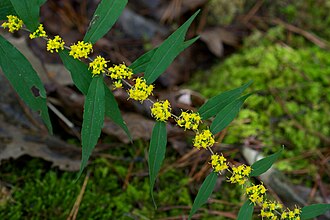
Also known as: Wreath Goldenrod
Blue-stemmed goldenrod does not hold its flowers in a plume at the top like most goldenrods; the small clusters sit in the leaf axils all along an arching, unbranched stem, so a plant reads as a wand of yellow rather than a torch. The stems carry a waxy purple-blue bloom that rubs off under a thumb, which is what names the plant. It is one of the few goldenrods genuinely happy in woodland shade and at a woods edge, and it stays modest enough not to bully a shade border. Goldenrods as a genus support more specialist bees and more caterpillar species than almost any other native plants, and this one carries its full share while looking nothing like a prairie species. Its pollen is heavy and insect-carried, so it has no part in hay fever — that is ragweed, blooming at the same time and going unnoticed. It creeps by short rhizomes into a loose drift rather than a mat.
- Family
- Asteraceae
- Type
- wildflower
- Lifespan
- perennial
- Height
- 1.5–3 ft
- Spacing
- 1.5–3 ft apart
- Light
- sun, part shade
- Soil moisture
- moist, dry
- Soil pH
- acidic, neutral
- Bloom
- August, September, October
- Bloom colors
- yellow
- Wildlife value
- butterflies, pollinators, songbirds, larval host
- Caterpillar hosts
- ~125 butterfly & moth species
- Landscape uses
- border, erosion control, naturalizing
- Native states
- AL, AR, CT, DE, FL, GA, IL, IN, KY, LA, MA, MD, ME, MI, MO, MS, NC, NH, NJ, NY, OH, OK, PA, RI, SC, TN, TX, VA, VT, WI, WV
Related native plants
More Solidago species
- Wrinkleleaf Goldenrod (Solidago rugosa)
- Seaside Goldenrod (Solidago sempervirens)
- Zigzag Goldenrod (Solidago flexicaulis)
- Tall Goldenrod (Solidago altissima)
- White Goldenrod (Solidago bicolor)
- Gray Goldenrod (Solidago nemoralis)