Indian Pink
Spigelia marilandica
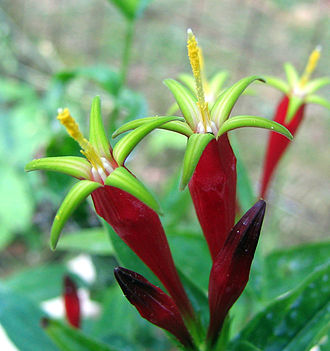
Indian pink holds upright red tubes in a one-sided row along the stem tip, each flaring at the mouth into a five-pointed yellow star — a combination shared by almost nothing else in an eastern woodland. The tube is sized almost exactly to a ruby-throated hummingbird's bill and effectively closed to everything else, which is why the plant is one of the most reliable hummingbird draws for a shaded bed. It is slow, clump-forming and very long-lived, gradually building a substantial mound that never runs. Cutting the stems back after the first flush usually brings a second, lighter bloom later in the season. It takes more sun than its woodland reputation suggests, as long as the soil never bakes dry. The plant is poisonous in quantity; it was once used medicinally as a vermifuge, at doses close enough to dangerous that the practice was abandoned.
- Family
- Loganiaceae
- Type
- wildflower
- Lifespan
- perennial
- Height
- 1–2 ft
- Spacing
- 0.5–1.5 ft apart
- Light
- part shade
- Soil moisture
- dry
- Soil pH
- acidic
- Bloom
- March, April, May
- Bloom colors
- red, yellow
- Wildlife value
- hummingbirds, songbirds
- Landscape uses
- naturalizing
- Native states
- AL, AR, FL, GA, IL, IN, KY, LA, MO, MS, NC, OK, SC, TN, TX