Heath Aster
Symphyotrichum ericoides
Also known as: White Heath Aster
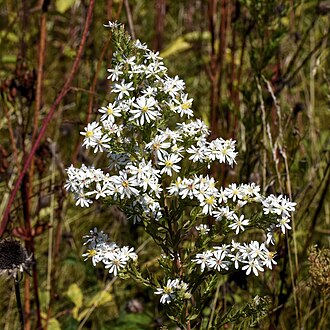
Heath aster looks like nothing much until September, when the whole bushy plant vanishes under hundreds of tiny white daisies packed so densely along arching side branches that the foliage disappears entirely. Those leaves are the reason for the name — narrow, stiff and needle-like, more heather than aster. It thrives on the poor, dry, gravelly ground where showier asters give up, and it is one of the last significant nectar sources of the season, carrying migrating monarchs and late bumblebee queens through October. Asters as a genus support an enormous number of native caterpillars and this one is among the most heavily used. It runs by rhizomes into wide low colonies, which is either the reason to plant it or the reason not to. Cut it back by half in early June and it returns denser and shorter without delaying bloom.
- Family
- Asteraceae
- Type
- wildflower
- Lifespan
- perennial
- Height
- 1–3 ft
- Spacing
- 1–1.5 ft apart
- Light
- sun
- Soil moisture
- dry
- Soil pH
- alkaline
- Bloom
- August, September, October
- Bloom colors
- white, pink, yellow, blue
- Wildlife value
- pollinators, butterflies, larval host
- Caterpillar hosts
- ~109 butterfly & moth species
- Landscape uses
- border, naturalizing
- Native states
- AL, AR, AZ, CO, CT, DE, GA, IA, ID, IL, IN, KS, MA, MD, ME, MI, MN, MO, MS, MT, ND, NE, NH, NJ, NM, NY, OH, OK, OR, PA, RI, SD, TN, TX, UT, VA, VT, WA, WI, WY
Related native plants
More Symphyotrichum species
- New England Aster (Symphyotrichum novae-angliae)
- Calico Aster (Symphyotrichum lateriflorum)
- Heart-leaved Aster (Symphyotrichum cordifolium)
- Smooth Blue Aster (Symphyotrichum laeve)
- Pacific Aster (Symphyotrichum chilense)
- Climbing Aster (Symphyotrichum carolinianum)