American Wisteria
Wisteria frutescens
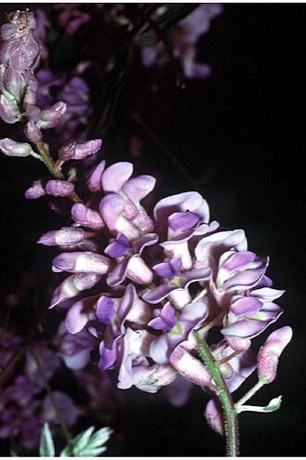
American wisteria is the native answer to the Asian wisterias that pull down porches and swallow woodlands: it climbs to a manageable size, twines rather than strangles, and its racemes are shorter, denser and less pendulous. It blooms on new wood after the leaves are out, which means late spring rather than early, and it reblooms lightly through summer — and it flowers young, in two or three years, where an Asian seedling can sulk for a decade. The flowers are blue to purple, only faintly fragrant, and bumblebees are strong enough to force the keel open where smaller bees are not. It fixes nitrogen and is a larval host for the silver-spotted skipper and the long-tailed skipper. Give it real support — a sturdy arbor or pergola, not a trellis it will eventually crush — and prune after it flowers. The seed of every wisteria is poisonous, and the pods are worth removing where children play.
- Family
- Fabaceae
- Type
- vine
- Lifespan
- perennial
- Height
- 15–30 ft
- Spacing
- 4–8 ft apart
- Light
- sun, part shade, shade
- Soil moisture
- moist
- Soil pH
- acidic, neutral
- Bloom
- May, June
- Bloom colors
- white, pink, blue, purple
- Wildlife value
- butterflies, larval host, pollinators
- Caterpillar hosts
- ~19 butterfly & moth species
- Landscape uses
- hedge or screen
- Native states
- AL, AR, DC, FL, GA, IL, IN, KY, LA, MA, MD, MI, MO, MS, NC, OH, OK, SC, TN, TX, VA