Gray's Sedge
Carex grayi
Also known as: Mace Sedge
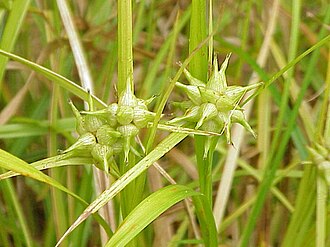
Gray's sedge is grown for its fruit rather than its foliage: each stem ends in a single green sphere of inflated sacs radiating in every direction, an inch or more across, exactly like a medieval mace — which is where the other common name comes from. Those heads dry to a pale tan with their spikes intact, making this one of the few sedges worth cutting for arrangements. The plant itself is a substantial upright clump of wide, flat, bright green leaves, coarser than most garden sedges and better used as a single accent than massed. It takes seasonal flooding without complaint and belongs in a rain garden, a swale, or the wet edge of a shaded bed. In the wild it grows in bottomland woods and floodplain forest across the eastern states, in ground saturated in spring and merely moist by August. Sparrows and waterfowl take the seed, and it is a larval host for several satyr butterflies.
- Family
- Cyperaceae
- Type
- grass
- Lifespan
- perennial
- Height
- 2–3 ft
- Spacing
- 1.5–2 ft apart
- Light
- part shade, sun, shade
- Soil moisture
- moist, wet
- Soil pH
- acidic, neutral
- Bloom
- May, June, July, August
- Bloom colors
- green
- Wildlife value
- songbirds, larval host
- Landscape uses
- specimen, border, rain garden, naturalizing
- Native states
- AL, AR, CT, DC, FL, GA, IA, IL, IN, KS, KY, MA, MD, MI, MN, MO, MS, NC, NJ, NY, OH, OK, PA, SC, TN, VA, VT, WI, WV
Related native plants
More Carex species
- Plantain-leaved Sedge (Carex plantaginea)
- Cherokee Sedge (Carex cherokeensis)
- Pennsylvania Sedge (Carex pensylvanica)
- Slough Sedge (Carex obnupta)
- Eastern Woodland Sedge (Carex blanda)
- Tussock Sedge (Carex stricta)