Tussock Sedge
Carex stricta
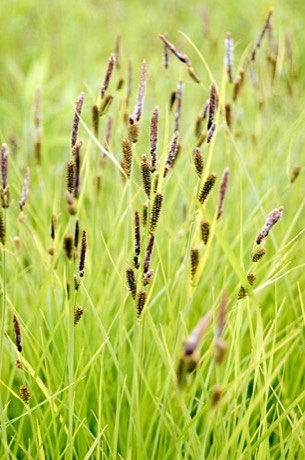
Tussock sedge builds its own microtopography, and that is the whole point of the plant: each clump accumulates its dead leaves and roots into a raised pedestal a foot or more high, so an old sedge meadow is a field of hummocks with standing water between them. That structure is habitat in itself — the tops stay dry enough for nesting sparrows, rails and turtles while the hollows hold water for amphibians, and a great many wetland species depend on the arrangement rather than on the plant. It is a dominant species of northern sedge meadows and wet prairies, often covering acres nearly alone. Growth is early and cool-season: it greens up while the marsh is still cold, flowers in May, and is tan by late summer. Its dense fibrous roots are among the best erosion control available for a shoreline whose water level moves. It is a larval host for several satyrs and skippers, and its seed feeds sparrows and waterfowl.
- Family
- Cyperaceae
- Type
- grass
- Lifespan
- perennial
- Height
- 1–3 ft
- Spacing
- 1–2 ft apart
- Light
- sun
- Soil moisture
- moist
- Soil pH
- acidic, neutral
- Bloom
- May, June
- Bloom colors
- green
- Wildlife value
- songbirds, butterflies, larval host
- Landscape uses
- specimen, border, naturalizing
- Native states
- AL, AR, CT, DC, DE, GA, IA, IL, IN, KS, KY, LA, MA, MD, ME, MI, MN, MO, MS, NC, ND, NE, NH, NJ, NY, OH, OK, PA, RI, SC, SD, TN, TX, VA, VT, WI, WV
Related native plants
More Carex species
- Gray's Sedge (Carex grayi)
- Plantain-leaved Sedge (Carex plantaginea)
- Cherokee Sedge (Carex cherokeensis)
- Pennsylvania Sedge (Carex pensylvanica)
- Slough Sedge (Carex obnupta)
- Eastern Woodland Sedge (Carex blanda)