Washington Hawthorn
Crataegus phaenopyrum
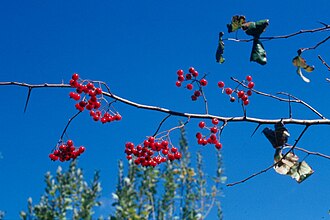
Washington hawthorn blooms late, after most trees have leafed out, then sets shining scarlet haws against fiery orange-red fall foliage. A favorite small specimen and screening tree. Like other hawthorns, the fruit is edible raw or cooked, though dry and rather marginal eating.
- Family
- Rosaceae
- Type
- tree
- Lifespan
- perennial
- Height
- 25–30 ft
- Spacing
- 25–30 ft apart
- Light
- sun
- Soil moisture
- moist
- Soil pH
- acidic, neutral
- Bloom
- June
- Bloom colors
- white
- Wildlife value
- butterflies, songbirds, larval host
- Caterpillar hosts
- ~168 butterfly & moth species
- Landscape uses
- hedge or screen
- Native states
- AL, AR, FL, GA, IA, IL, IN, KY, MA, MD, MO, MS, NC, OH, PA, SC, TN, VA, WV
Related native plants
More Crataegus species
- Parsley Hawthorn (Crataegus marshallii)
- Black Hawthorn (Crataegus douglasii)
- Littlehip Hawthorn (Crataegus spathulata)
- Cockspur Hawthorn (Crataegus crus-galli)
- Green Hawthorn (Crataegus viridis)
- Downy Hawthorn (Crataegus mollis)