Northern Bush Honeysuckle
Diervilla lonicera
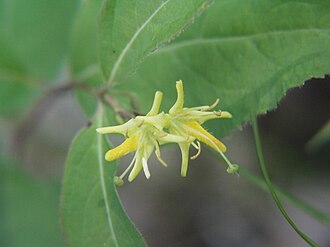
Northern bush honeysuckle is a true native honeysuckle and behaves nothing like the invasive Asian shrubs that share the name — it stays knee-high and holds its ground instead of seeding into woodlands. Small tubular yellow flowers open a few at a time from June into August and deepen to orange and red as they age, so one plant shows several colors at once; hummingbirds and long-tongued bees work them all summer. It is among the best natives for dry shade and raw slopes, spreading by shallow suckers just enough to knit a bank together. Foliage emerges bronze, greens up, then turns red in fall, and the whole plant stays small enough for spots where a viburnum would be too much. It asks for nothing: poor soil, drought and root competition are all fine by it.
- Family
- Caprifoliaceae
- Type
- shrub
- Lifespan
- perennial
- Height
- 2–3 ft
- Spacing
- 2–4 ft apart
- Light
- part shade, shade
- Soil moisture
- dry
- Soil pH
- acidic, neutral
- Bloom
- June, July, August
- Bloom colors
- red, orange, yellow, purple
- Wildlife value
- pollinators
- Landscape uses
- foundation
- Native states
- AL, CT, DC, DE, IA, IL, IN, MA, MD, ME, MI, MN, NC, ND, NH, NJ, NY, OH, PA, RI, TN, VA, VT, WI, WV