California Buckwheat
Eriogonum fasciculatum
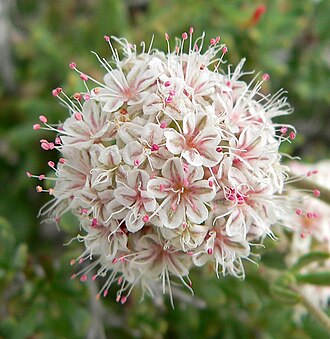
California buckwheat carries dense flat clusters of small white to pink flowers from late spring into fall, and they fade and dry in place rather than dropping, so they hold on the plant for months and give a dry slope structure through the whole rainless season. Few California natives support more insect life: it is a nectar source for an exceptional range of native bees, wasps and butterflies, and a larval host for several blues and hairstreaks. It is a backbone shrub of coastal sage scrub, low and wide-spreading, and one of the standard species for revegetating road cuts and fire-scarred hillsides. It wants full sun, sharp drainage and no summer water once established; irrigation shortens its life considerably. Cut it back lightly after flowering to keep it dense rather than woody and open at the base.
- Family
- Polygonaceae
- Type
- shrub
- Lifespan
- perennial
- Height
- 3–3 ft
- Spacing
- 2–5 ft apart
- Light
- sun
- Soil moisture
- dry
- Soil pH
- neutral, alkaline
- Bloom
- May, June, July, August, September, October
- Bloom colors
- white, pink
- Wildlife value
- pollinators, butterflies, songbirds, larval host
- Landscape uses
- foundation
- Native states
- AZ, CA, NV, UT
Related native plants
More Eriogonum species
- Sulphur Buckwheat (Eriogonum umbellatum)
- Desert Trumpet (Eriogonum inflatum)
- Redroot Buckwheat (Eriogonum racemosum)
- St. Catherine's Lace (Eriogonum giganteum)
- Santa Cruz Island Buckwheat (Eriogonum arborescens)
- Lobb's Buckwheat (Eriogonum lobbii)