Cucumber Tree
Magnolia acuminata
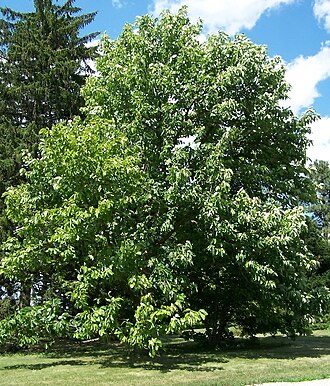
Also known as: Cucumber Magnolia
Cucumber tree ranges farther north than any other American magnolia and is the only one native to Canada, which is what lets a genus most people file under the Deep South grow as a forest tree in Ontario and Ohio. Its flowers are the least showy in the genus: greenish-yellow, held upright and largely hidden among the leaves high in the crown, so a tree in full bloom can go unnoticed from the ground. The name comes from the young fruit, a knobby green cylinder that really does resemble a small cucumber before it ripens and splits to dangle scarlet seeds on slender threads. Those seeds are heavy and oily, and towhees, thrushes and squirrels take them straight off the tree. It grows fast and straight into a tall pyramidal shade tree, wants deep moist soil, and resents drought and compaction.
- Family
- Magnoliaceae
- Type
- tree
- Lifespan
- perennial
- Height
- 40–70 ft
- Spacing
- 20–35 ft apart
- Light
- sun, part shade, shade
- Soil moisture
- moist, wet
- Soil pH
- acidic, neutral
- Bloom
- May, June
- Bloom colors
- yellow, green, brown
- Wildlife value
- mammals, songbirds, larval host
- Caterpillar hosts
- ~21 butterfly & moth species
- Landscape uses
- specimen, rain garden
- Native states
- AL, AR, FL, GA, IL, IN, KY, LA, MA, MD, MO, MS, NC, NY, OH, OK, PA, SC, TN, VA, WV
Related native plants
More Magnolia species
- Southern Magnolia (Magnolia grandiflora)
- Sweetbay Magnolia (Magnolia virginiana)
- Umbrella Magnolia (Magnolia tripetala)
- Bigleaf Magnolia (Magnolia macrophylla)
- Pyramid Magnolia (Magnolia pyramidata)