Sweet Crabapple
Malus coronaria
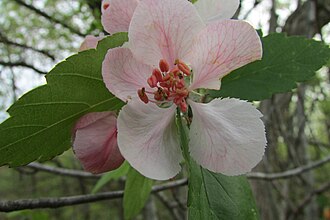
Sweet crabapple perfumes the late-spring woods with intensely fragrant pink-and-white bloom, followed by hard green crabapples used for jelly and eaten by wildlife. A broad, often thorny native orchard tree. As with every apple, the flesh is the food and the seeds are cyanogenic — worth knowing when milling fruit for jelly, though the flesh itself carries none.
- Family
- Rosaceae
- Type
- tree
- Lifespan
- perennial
- Height
- 15–25 ft
- Spacing
- 15–25 ft apart
- Light
- part shade
- Soil moisture
- moist
- Soil pH
- neutral, acidic
- Bloom
- April, May, June
- Bloom colors
- white, pink
- Wildlife value
- pollinators, butterflies, mammals, songbirds, larval host
- Caterpillar hosts
- ~308 butterfly & moth species
- Landscape uses
- naturalizing
- Native states
- AL, AR, DC, DE, GA, IL, IN, KS, KY, LA, MD, MI, MO, MS, NC, NJ, NY, OH, PA, SC, TN, VA, WI, WV
Related native plants
More Malus species
- Pacific Crabapple (Malus fusca)
- Southern Crabapple (Malus angustifolia)
- Prairie Crabapple (Malus ioensis)