Common Ninebark
Physocarpus opulifolius
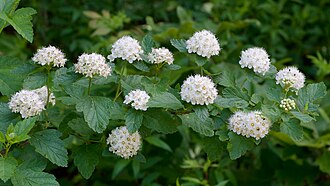
Ninebark takes its name from mature bark that peels away in thin papery layers, brown over tan over cinnamon, which is the shrub's real asset once the leaves are gone. Rounded clusters of small white flowers in late spring give way to inflated red seed capsules that dry and hold, and both stages cut well for arrangements. It is among the toughest shrubs available for a native planting — flooding, drought, clay, cold and road salt all pass without complaint — and it is a workhorse for streambank stabilization. It does suffer in humid shade, where powdery mildew disfigures it, and the dark-leaved garden cultivars are noticeably more prone to it than the plain green species. Cut a third of the oldest stems to the ground each late winter and it stays dense rather than arching open at the middle. It is not a food plant, and large medicinal doses of it are toxic.
- Family
- Rosaceae
- Type
- shrub
- Lifespan
- perennial
- Height
- 5–8 ft
- Spacing
- 4–6 ft apart
- Light
- sun, part shade, shade
- Soil moisture
- dry, moist, wet
- Soil pH
- acidic, neutral
- Bloom
- May, June
- Bloom colors
- white, pink
- Wildlife value
- pollinators, butterflies, mammals, songbirds, larval host
- Caterpillar hosts
- ~41 butterfly & moth species
- Landscape uses
- border, hedge or screen, naturalizing, rain garden
- Native states
- AL, AR, CO, CT, DC, DE, FL, GA, IA, IL, IN, KS, KY, MA, MD, MI, MN, MO, NC, ND, NE, NH, NJ, NY, OH, OK, PA, RI, SC, SD, TN, VA, WI, WV
Related native plants
More Physocarpus species
- Pacific Ninebark (Physocarpus capitatus)
- Mallow Ninebark (Physocarpus malvaceus)
- Mountain Ninebark (Physocarpus monogynus)