Meadowsweet
Spiraea alba
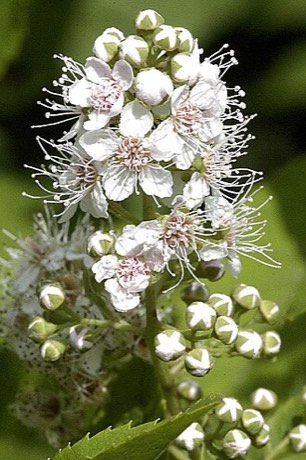
Meadowsweet carries narrow, steeple-shaped panicles of tiny white flowers from midsummer well into fall, long after most shrubs have finished. It belongs in wet ground — pond edges, ditches, sedge meadows — and is one of the few woody plants that will knit a saturated shoreline together without sulking. Its flowers are shallow and open, which suits short-tongued bees, small wasps and syrphid flies rather than the long-tongued specialists, and the foliage feeds a long list of native caterpillars. Old flower heads dry to a rust brown and stand through winter, so leave them up. An infusion of the leaves tastes much like black tea. Up close it is a modest, twiggy thing, and it works far better massed than as a single specimen.
- Family
- Rosaceae
- Type
- shrub
- Lifespan
- perennial
- Height
- 3–4 ft
- Spacing
- 3–4 ft apart
- Light
- sun, part shade, shade
- Soil moisture
- moist, wet
- Soil pH
- acidic, neutral
- Bloom
- June, July, August, September
- Bloom colors
- white
- Wildlife value
- songbirds, butterflies, larval host
- Caterpillar hosts
- ~89 butterfly & moth species
- Landscape uses
- border, naturalizing, rain garden
- Native states
- CT, DE, GA, IA, IL, IN, KY, MA, MD, ME, MI, MN, MO, NC, ND, NH, NJ, NY, OH, PA, RI, SD, TN, VA, VT, WI, WV
Related native plants
More Spiraea species
- Steeplebush (Spiraea tomentosa)
- Douglas Spirea (Spiraea douglasii)
- Rosy Spirea (Spiraea splendens)
- Broadleaf Meadowsweet (Spiraea latifolia)
- Birchleaf Spirea (Spiraea betulifolia)