Steeplebush
Spiraea tomentosa
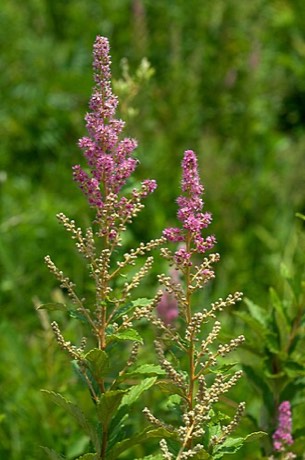
Steeplebush sends up narrow tapering spires of rose-pink flowers that open from the top downward — the reverse of most spikes — so through late summer a colony shows a band of color working steadily down each stem. The undersides of its leaves and its stems are covered in dense tawny wool, which is the quickest way to tell it from the white-flowered meadowsweets it often grows beside. It runs by short rhizomes into low thickets in wet meadows, bogs and abandoned pasture, tolerating acidic, infertile, saturated ground that defeats most shrubs. Flowering as late as it does, it carries pollinators across the gap between the midsummer peak and the fall asters. Left standing, the rusty seed spires hold their shape all winter and are among the better small-shrub silhouettes in snow.
- Family
- Rosaceae
- Type
- shrub
- Lifespan
- perennial
- Height
- 2–4 ft
- Spacing
- 3–5 ft apart
- Light
- sun, part shade, shade
- Soil moisture
- moist
- Soil pH
- acidic, neutral
- Bloom
- July, August, September
- Bloom colors
- red, pink, purple
- Wildlife value
- songbirds, butterflies, larval host
- Caterpillar hosts
- ~89 butterfly & moth species
- Landscape uses
- border, naturalizing, rain garden
- Native states
- AL, AR, CT, DE, GA, IL, IN, KS, KY, MA, MD, ME, MI, MN, MO, MS, NC, NH, NJ, NY, OH, PA, RI, SC, TN, VA, VT, WA, WI, WV
Related native plants
More Spiraea species
- Meadowsweet (Spiraea alba)
- Douglas Spirea (Spiraea douglasii)
- Rosy Spirea (Spiraea splendens)
- Broadleaf Meadowsweet (Spiraea latifolia)
- Birchleaf Spirea (Spiraea betulifolia)