Silky Aster
Symphyotrichum sericeum
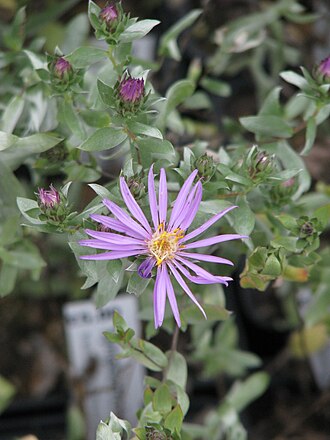
Silky aster is the most distinctive aster on a dry prairie even out of flower: small oval leaves covered so densely in flat-lying silky hairs that the whole plant reads as silver, catching light like a piece of pewter in the grass. In September and October it opens relatively large purple daisies directly against that silver foliage, and the contrast is the reason to seek the plant out. It is a specialist of thin, dry, rocky ground — limestone glades, gravel hills, the driest edges of a prairie — and it is uncompetitive, so it disappears from anywhere with fertility or heavy grass cover. It stays small at a foot or two and forms a slow clump from a woody crown rather than running. Asters carry an enormous caterpillar load, and its late bloom feeds bees and monarchs heading south. It is slow from seed and needs a spot where nothing will crowd it.
- Family
- Asteraceae
- Type
- wildflower
- Lifespan
- perennial
- Height
- 1–2 ft
- Spacing
- 1–2 ft apart
- Light
- sun, part shade
- Soil moisture
- dry
- Soil pH
- neutral, alkaline
- Bloom
- September, October
- Bloom colors
- pink, blue, purple
- Wildlife value
- butterflies, larval host
- Caterpillar hosts
- ~109 butterfly & moth species
- Landscape uses
- border, container
- Native states
- AR, IA, IL, IN, KS, MI, MN, MO, ND, NE, OH, OK, SD, TN, TX, VA, WI
Related native plants
More Symphyotrichum species
- New England Aster (Symphyotrichum novae-angliae)
- Calico Aster (Symphyotrichum lateriflorum)
- Heart-leaved Aster (Symphyotrichum cordifolium)
- Heath Aster (Symphyotrichum ericoides)
- Smooth Blue Aster (Symphyotrichum laeve)
- Pacific Aster (Symphyotrichum chilense)