Massachusetts Fern
Thelypteris simulata
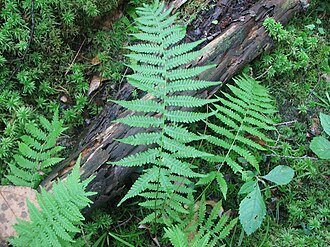
Massachusetts fern is a plant of acidic Northeastern swamps, red maple bogs and boggy woods, growing in saturated sphagnum and peat where few other ferns persist. Its fronds are delicate and a pale yellow-green, and it spreads by slender creeping rhizomes into airy open colonies rather than crowns, so individual fronds stand well apart from one another. It is easily confused with New York fern and marsh fern, close relatives sharing the same habitat; the reliable difference is the lowest pair of leaflets, which point downward here and are only slightly shortened. Its range is narrow — mainly New England and the mid-Atlantic with scattered outlying populations — and it is uncommon enough to be tracked by several states. It needs cool, wet, strongly acidic shade and is not a garden plant in any ordinary sense. Where it grows, the water table sits at or near the surface year round.
- Family
- Thelypteridaceae
- Type
- fern
- Lifespan
- perennial
- Height
- 1–2 ft
- Spacing
- 1–1.5 ft apart
- Light
- part shade
- Soil moisture
- wet
- Soil pH
- acidic
- Landscape uses
- groundcover, container, rain garden, erosion control, naturalizing
- Native states
- CT, DC, DE, MA, MD, ME, NC, NH, NJ, NY, PA, RI, TN, VA, VT, WI, WV
Related native plants
More Thelypteris species
- New York Fern (Thelypteris noveboracensis)
- Marsh Fern (Thelypteris palustris)
- Southern Shield Fern (Thelypteris kunthii)