Atamasco Lily
Zephyranthes atamasca
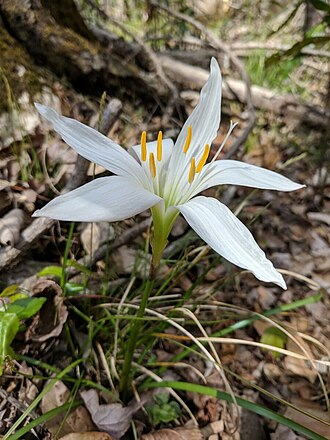
Atamasco lily comes up in sheets after heavy spring rain, carpeting damp woods, ditches and low pastures in white crocus-shaped flowers held singly on bare stalks — the reason for the common name rain lily. The flowers blush pink as they age and each lasts only a few days, but a colony opens in waves, so a good site holds bloom for weeks. Narrow, glossy, grass-like leaves come up with the flowers and die back by early summer, leaving nothing above ground until the following spring. It grows from a bulb and wants ground that is wet in winter and spring and dry afterward, exactly the regime of a Southeastern flatwoods. The bulbs contain toxic compounds, and horses are reported to get the staggers, a cerebrospinal disease, from eating the leaves and bulbs — a real hazard where the plant comes up in pasture. Its only documented human use is as a cooked emergency food, which is not a reason to forage it.
- Family
- Amaryllidaceae
- Type
- wildflower
- Lifespan
- perennial
- Height
- 1–2 ft
- Spacing
- 0.5–1 ft apart
- Light
- part shade, shade
- Soil moisture
- moist, wet
- Soil pH
- acidic, alkaline
- Bloom
- March, April, May, June
- Bloom colors
- white, pink
- Wildlife value
- pollinators, songbirds
- Landscape uses
- border, naturalizing, rain garden
- Native states
- AL, FL, GA, LA, MD, MS, NC, SC, VA