Nodding Onion
Allium cernuum
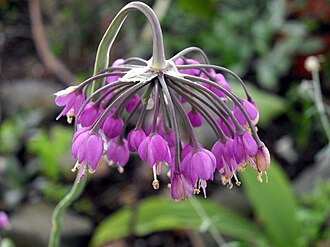
Nodding onion earns its name twice: the flower stalk bends into a sharp crook just below the head so the pink umbel hangs face down, then straightens as the seed ripens to hold the capsules upright. It is a true onion, and bulb, leaves and flowers are all edible — the leaves strongly and pleasantly oniony in a salad, the bulbs strong enough that they are mainly used as a flavoring. The flowers are small and shallow and pull in an unusually wide range of short-tongued bees and wasps at a point in midsummer when many prairie forbs are between bloom periods. It stays tidy at about a foot, builds slow clumps from bulb offsets, and self-sows gently without becoming a nuisance. Deer and rabbits leave it alone, the usual advantage of an onion. Note that alliums are toxic to dogs, which are unusually susceptible to the genus.
- Family
- Amaryllidaceae
- Type
- wildflower
- Lifespan
- perennial
- Height
- 1–1.5 ft
- Spacing
- 0.25–0.5 ft apart
- Light
- sun
- Soil moisture
- moist
- Soil pH
- alkaline, neutral
- Bloom
- June, July, August
- Bloom colors
- white, pink
- Wildlife value
- butterflies, hummingbirds, pollinators
- Landscape uses
- border, naturalizing
- Native states
- AL, AR, AZ, CO, DC, GA, IA, ID, IL, IN, KY, MD, MI, MN, MO, MS, MT, NC, NE, NM, NY, OH, OR, PA, SC, SD, TN, TX, UT, VA, WA, WI, WV, WY
Related native plants
More Allium species
- Ramps (Allium tricoccum)
- Wild Garlic (Allium canadense)
- Swamp Onion (Allium validum)
- Prairie Onion (Allium stellatum)
- One-leaf Onion (Allium unifolium)
- Largeflower Onion (Allium macropetalum)