Brome-like Sedge
Carex bromoides
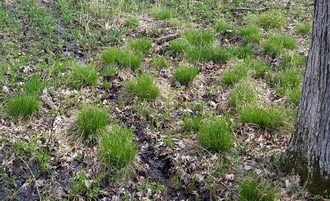
Brome-like sedge is the finest-textured of the eastern wetland sedges, its leaves barely a sixteenth of an inch wide, arching out into soft low tussocks that read almost as mown lawn from a distance. It is named for the resemblance of its slender seed spikes to a brome grass, and it flowers very early, often in March, well ahead of most sedges. It grows in seeps, spring runs, wet woods and the mucky margins of shaded streams, frequently in colonies dense enough to exclude everything else. Because it holds most of its foliage through winter and stays under a foot, it is one of the better native substitutes for a shade lawn in ground too wet for turf. The tussocks are soft enough to cross occasionally, though not to take real traffic. It asks for shade and steady moisture, and it browns out in a dry summer.
- Family
- Cyperaceae
- Type
- grass
- Lifespan
- perennial
- Height
- 0.75–1 ft
- Spacing
- 1.25–1.75 ft apart
- Light
- sun, part shade
- Soil moisture
- moist
- Soil pH
- acidic, neutral
- Bloom
- March, April, May, June
- Bloom colors
- green, brown
- Wildlife value
- butterflies, songbirds
- Landscape uses
- groundcover, rain garden
- Native states
- AL, AR, CT, DC, DE, FL, GA, IL, IN, KY, LA, MA, MD, ME, MI, MN, MO, MS, NC, NH, NJ, NY, OH, PA, RI, SC, TN, TX, VA, VT, WI, WV
Related native plants
More Carex species
- Gray's Sedge (Carex grayi)
- Plantain-leaved Sedge (Carex plantaginea)
- Cherokee Sedge (Carex cherokeensis)
- Pennsylvania Sedge (Carex pensylvanica)
- Slough Sedge (Carex obnupta)
- Eastern Woodland Sedge (Carex blanda)