Fringed Sedge
Carex crinita
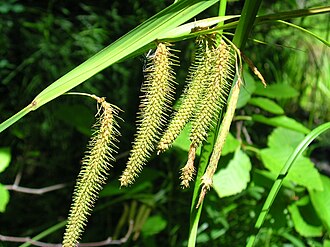
Fringed sedge is the weeping one: its seed spikes hang from thread-fine stalks in long, soft, caterpillar-like tassels that sway in any breeze, three or four inches long and covered in the fine bristles that give the plant its name. A clump in fruit over water, tassels reflected, holds its own against any ornamental grass — and it does it in shade, where most fine-textured plants will not perform. The foliage is a substantial arching mound of wide leaves with rough, saw-toothed edges; run a finger the wrong way and it will catch. It grows along stream banks and in wet woods, seeps and swamp edges through the East, wanting shade and soil that stays damp. The seed heads darken and shatter by fall, so cut it for arrangements while the tassels are still green. Sparrows and wood ducks take the seed.
- Family
- Cyperaceae
- Type
- grass
- Lifespan
- perennial
- Height
- 1–3 ft
- Spacing
- 1–2 ft apart
- Light
- part shade, shade
- Soil moisture
- moist
- Soil pH
- acidic, neutral
- Bloom
- June, July, August
- Bloom colors
- white, green, brown
- Wildlife value
- songbirds
- Landscape uses
- naturalizing, rain garden
- Native states
- AL, AR, CT, DC, DE, FL, GA, IA, IL, IN, KY, LA, MA, MD, ME, MI, MN, MO, MS, NC, NH, NJ, NY, OH, OK, PA, RI, SC, TN, TX, VA, VT, WI, WV
Related native plants
More Carex species
- Gray's Sedge (Carex grayi)
- Plantain-leaved Sedge (Carex plantaginea)
- Cherokee Sedge (Carex cherokeensis)
- Pennsylvania Sedge (Carex pensylvanica)
- Slough Sedge (Carex obnupta)
- Eastern Woodland Sedge (Carex blanda)