Hairy Green Sedge
Carex hirsutella
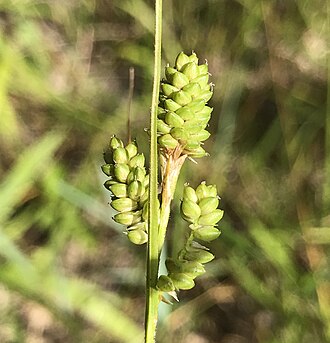
Hairy green sedge is the one to reach for when the problem is dry shade over clay — a combination that defeats most sedges, since the genus runs heavily to wetland species. It makes a modest arching clump of narrow leaves covered in fine soft hairs, which give it a matte, slightly gray-green cast and a texture unlike the glossy woodland sedges it grows among. It is a common component of old oak woods, upland pasture and thin-soiled openings through the eastern states, tolerant of root competition and of being walked over. Flowering is early and modest, slender spikes barely clearing the leaves in April, so this is a foliage plant — and it holds that foliage cleanly all season without staking or cutting back. Massed at a foot apart it closes into a durable groundcover under trees within two or three seasons. Sparrows and small mammals take the seed, and it is a larval host for satyr butterflies.
- Family
- Cyperaceae
- Type
- grass
- Lifespan
- perennial
- Height
- 1–2 ft
- Spacing
- 1–1.5 ft apart
- Light
- sun, part shade
- Soil moisture
- dry, moist
- Soil pH
- neutral, acidic
- Bloom
- April, May, June
- Bloom colors
- yellow, green, brown
- Wildlife value
- songbirds, larval host, mammals
- Landscape uses
- border, container, naturalizing
- Native states
- AL, AR, CT, DC, DE, GA, IA, IL, IN, KS, KY, LA, MA, MD, ME, MI, MO, MS, NC, NJ, NY, OH, OK, PA, RI, SC, TN, TX, VA, VT, WV
Related native plants
More Carex species
- Gray's Sedge (Carex grayi)
- Plantain-leaved Sedge (Carex plantaginea)
- Cherokee Sedge (Carex cherokeensis)
- Pennsylvania Sedge (Carex pensylvanica)
- Slough Sedge (Carex obnupta)
- Eastern Woodland Sedge (Carex blanda)