Largehead Sedge
Carex macrocephala
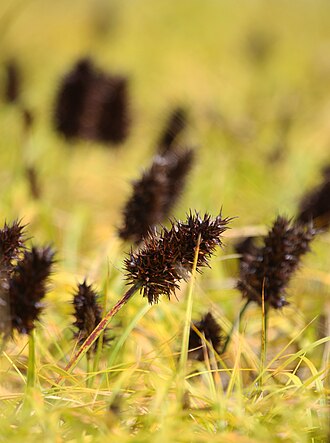
Largehead sedge is a beach plant and behaves like one: stout rhizomes run laterally through loose sand, sending up short tufts of stiff yellow-green leaves that survive burial and push up again through fresh drift, which is exactly the behavior that builds and holds a dune. It grows on open sand along the Pacific coast from northern California to Alaska and around to Japan, rarely more than a few hundred feet from the water. The seed heads are the reason for the name: male and female spikes are borne on separate plants, and the female heads swell into hard, spiny, straw-colored balls two or three inches across, formidable enough to be unpleasant underfoot. Those heads break free and travel, part of how the plant reaches new beaches. It is among the more effective natives for stabilizing coastal sand, asking for nothing but sun and salt spray. Both the root and the seed are documented as food, though the seed is small and fiddly to use.
- Family
- Cyperaceae
- Type
- grass
- Lifespan
- perennial
- Height
- 0.3–1 ft
- Spacing
- 1–3 ft apart
- Light
- sun
- Soil moisture
- moist, wet
- Soil pH
- neutral
- Bloom
- April, May, June, July
- Bloom colors
- green, brown
- Wildlife value
- songbirds, larval host, mammals
- Landscape uses
- border, groundcover, container, rain garden, erosion control, naturalizing
- Native states
- AK, OR, WA
Related native plants
More Carex species
- Gray's Sedge (Carex grayi)
- Plantain-leaved Sedge (Carex plantaginea)
- Cherokee Sedge (Carex cherokeensis)
- Pennsylvania Sedge (Carex pensylvanica)
- Slough Sedge (Carex obnupta)
- Eastern Woodland Sedge (Carex blanda)