Palm Sedge
Carex muskingumensis
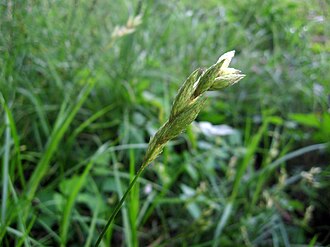
Palm sedge looks like nothing else in the genus: its leaves radiate in flat whorls from the top of each upright stem, so a clump reads as a stand of miniature palm trees a foot or two high rather than a fountain of grass. Those stems are strong enough to hold the arrangement all season, and they turn a clean butter yellow before collapsing in fall. It is a floodplain plant, named for the Muskingum River in Ohio, and it is narrowly distributed through the Ohio and Mississippi valleys in bottomland forest that floods each spring. It takes standing water and ordinary garden moisture equally, and it will grow in nearly full shade — one of very few plants able to carry a design in wet shade. It creeps slowly by short rhizomes into a colony without becoming a problem, and it divides easily in spring. It is a larval host for several satyrs, and its seed feeds sparrows and wood ducks.
- Family
- Cyperaceae
- Type
- grass
- Lifespan
- perennial
- Height
- 2–3 ft
- Spacing
- 2–3 ft apart
- Light
- sun, part shade, shade
- Soil moisture
- moist
- Soil pH
- acidic, neutral
- Bloom
- May, June
- Bloom colors
- white, green, brown
- Wildlife value
- songbirds, larval host
- Landscape uses
- specimen, border, naturalizing
- Native states
- AR, IA, IL, IN, KS, KY, MI, MN, MO, OH, OK, TN, WI
Related native plants
More Carex species
- Gray's Sedge (Carex grayi)
- Plantain-leaved Sedge (Carex plantaginea)
- Cherokee Sedge (Carex cherokeensis)
- Pennsylvania Sedge (Carex pensylvanica)
- Slough Sedge (Carex obnupta)
- Eastern Woodland Sedge (Carex blanda)