Knotsheath Sedge
Carex retrorsa
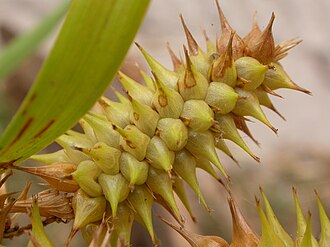
Knotsheath sedge is named for what its fruiting spikes do: the individual sacs bend sharply backward and downward as they ripen, so a mature head bristles in reverse — a reliable field character in a genus where identification usually turns on details this small. The spikes crowd together near the top of the stem, often with the lowest one held well below the rest on a long stalk of its own. It is a northern wetland plant, growing in marshes, alder swamps, wet ditches and beaver meadows from New England across the Great Lakes and into the Rockies. Its foliage is a soft yellow-green in a loose upright clump that stays presentable into winter. It is one of the sedges that colonizes disturbed wet ground quickly, turning up in new ditches and drawdown zones ahead of slower species. Sparrows and waterfowl take the seed, and it hosts satyr caterpillars.
- Family
- Cyperaceae
- Type
- grass
- Lifespan
- perennial
- Height
- 1–3 ft
- Spacing
- 1–1.5 ft apart
- Light
- part shade, shade
- Soil moisture
- moist
- Soil pH
- acidic, neutral
- Bloom
- June, July, August
- Bloom colors
- green, brown
- Wildlife value
- songbirds, larval host, mammals
- Landscape uses
- specimen, border, naturalizing
- Native states
- CO, CT, IA, ID, IL, IN, MA, ME, MI, MN, MT, ND, NH, NJ, NY, OH, OR, PA, RI, SD, UT, VT, WA, WI, WY
Related native plants
More Carex species
- Gray's Sedge (Carex grayi)
- Plantain-leaved Sedge (Carex plantaginea)
- Cherokee Sedge (Carex cherokeensis)
- Pennsylvania Sedge (Carex pensylvanica)
- Slough Sedge (Carex obnupta)
- Eastern Woodland Sedge (Carex blanda)