Sartwell's Sedge
Carex sartwellii
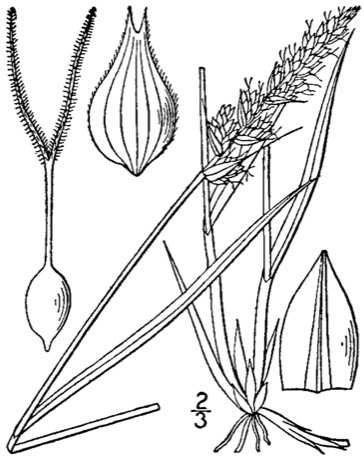
Sartwell's sedge is one of the running sedges, spreading by long slender rhizomes into even, single-species stands rather than discrete clumps, so a colony reads as a uniform sward of upright narrow leaves with no individual plants visible in it. That habit is its value in restoration: it closes bare wet ground quickly and then holds it, and it is a standard species for rebuilding a sedge meadow or stabilizing a wet prairie swale. Its flowering stems are unusual in the genus for carrying male and female flowers mixed within the same narrow spike rather than in separate ones, which is how it is keyed out. It grows in calcareous wet prairies, fens and marsh edges through the upper Midwest and Great Lakes, wanting sun and ground that stays wet into summer. The foliage stays partly green through winter and the stands hold snow well. Its root and seed are both on record as food, without further detail.
- Family
- Cyperaceae
- Type
- grass
- Lifespan
- perennial
- Height
- 1–3 ft
- Spacing
- 1–2 ft apart
- Light
- sun, part shade
- Soil moisture
- moist, wet
- Soil pH
- neutral, alkaline
- Bloom
- June, July
- Bloom colors
- green, brown
- Wildlife value
- songbirds, larval host, mammals
- Landscape uses
- specimen, border, rain garden, erosion control, naturalizing
- Native states
- AK, CO, IA, ID, IL, IN, KS, MI, MN, MO, MT, ND, NE, NY, OH, PA, SD, WI, WY
Related native plants
More Carex species
- Gray's Sedge (Carex grayi)
- Plantain-leaved Sedge (Carex plantaginea)
- Cherokee Sedge (Carex cherokeensis)
- Pennsylvania Sedge (Carex pensylvanica)
- Slough Sedge (Carex obnupta)
- Eastern Woodland Sedge (Carex blanda)