Low Woodland Sedge
Carex socialis
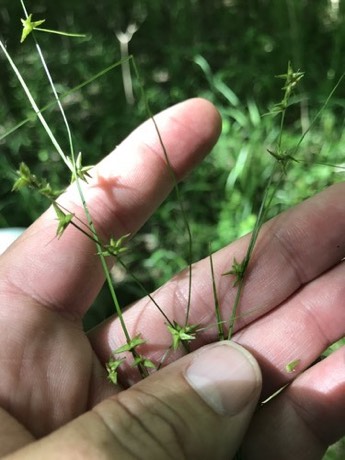
Low woodland sedge is aptly named twice over: it stays under eighteen inches, and it is social, running by rhizomes into broad soft colonies rather than standing as separate clumps. It grows in the moist bottomland woods and swamp forests of the lower Mississippi valley and the mid-South, in ground that floods in winter and dries only at the surface in summer. Its leaves are soft, narrow and a clear bright green, and enough of them persist through the cold months that a colony never looks bare. That combination — low, spreading, shade-tolerant, and green enough in winter to matter — makes it one of the easiest native groundcovers for damp shade, where it will knit a large area with almost no maintenance. Flowering is early and inconspicuous, slender spikes among the leaves in April, and there is no reason to cut it back. Sparrows and small mammals take the seed, and satyr caterpillars feed on the foliage.
- Family
- Cyperaceae
- Type
- grass
- Lifespan
- perennial
- Height
- 0.5–1.5 ft
- Spacing
- 1–1.5 ft apart
- Light
- sun, part shade
- Soil moisture
- wet, moist
- Soil pH
- acidic, neutral
- Bloom
- April, May
- Bloom colors
- yellow, green, brown
- Wildlife value
- songbirds, larval host, mammals
- Landscape uses
- border, groundcover, container, rain garden, erosion control, naturalizing
- Native states
- AL, AR, GA, IL, IN, KS, KY, LA, MO, MS, NC, OK, SC, TN, TX
Related native plants
More Carex species
- Gray's Sedge (Carex grayi)
- Plantain-leaved Sedge (Carex plantaginea)
- Cherokee Sedge (Carex cherokeensis)
- Pennsylvania Sedge (Carex pensylvanica)
- Slough Sedge (Carex obnupta)
- Eastern Woodland Sedge (Carex blanda)