American Holly
Ilex opaca
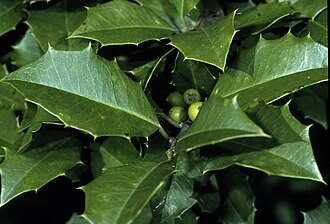
American holly is the classic evergreen holly, with spiny leaves and bright red winter berries borne only on female trees, so a male has to stand within range for fruit to set. It is slow but very long-lived, and its dense evergreen structure makes it one of the best cover and nesting shrubs a songbird can have in winter. Birds leave the fruit until late in the season, after repeated freezing has broken down its bitterness, which is why the display lasts into February. The roasted leaves were a popular caffeine-free tea substitute during the Civil War. The berries are poisonous to people: like others in the genus they carry saponins and can cause vomiting, diarrhea and stupor if eaten in quantity — worth knowing, since cut holly comes indoors at exactly the season the fruit is ripe.
- Family
- Aquifoliaceae
- Type
- tree
- Lifespan
- perennial
- Height
- 15–30 ft
- Spacing
- 10–20 ft apart
- Light
- sun, part shade, shade
- Soil moisture
- dry, wet
- Soil pH
- acidic, neutral
- Bloom
- March, April, May, June
- Bloom colors
- white, green
- Wildlife value
- songbirds, butterflies, larval host
- Caterpillar hosts
- ~39 butterfly & moth species
- Landscape uses
- hedge or screen, rain garden
- Native states
- AL, AR, CT, DC, DE, FL, GA, IN, KY, LA, MA, MD, MO, MS, NC, NJ, NY, OH, OK, PA, RI, SC, TN, TX, VA, WV
Related native plants
More Ilex species
- Yaupon Holly (Ilex vomitoria)
- Winterberry Holly (Ilex verticillata)
- Possumhaw (Ilex decidua)
- Inkberry (Ilex glabra)
- Dahoon Holly (Ilex cassine)
- Large Gallberry (Ilex coriacea)