Winterberry Holly
Ilex verticillata
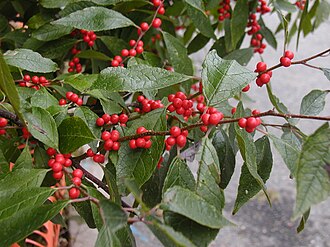
Winterberry is a deciduous holly, so its fruit arrives on bare gray twigs and reads from a hundred yards in December — the reason cut stems are a florist staple. Plants are male or female and only females fruit, so at least one male overlapping in bloom has to stand within about fifty feet. It takes wet ground better than almost any garden shrub, thriving at pond edges and in ditches that never drain, and it wants acidic soil. Robins, bluebirds and waxwings strip the berries late in winter, after repeated freezing and thawing has softened them, which is why the display lasts as long as it does. The berries are poisonous to people: like others in the genus they carry saponins and can cause vomiting, diarrhea and stupor if eaten in quantity. A caffeine-free tea is made from the dried leaves.
- Family
- Aquifoliaceae
- Type
- tree
- Lifespan
- perennial
- Height
- 6–12 ft
- Spacing
- 6–12 ft apart
- Light
- sun, part shade, shade
- Soil moisture
- dry, moist, wet
- Soil pH
- acidic, neutral
- Bloom
- April, May, June, July
- Bloom colors
- white, yellow, green, brown
- Wildlife value
- songbirds, butterflies, larval host
- Caterpillar hosts
- ~39 butterfly & moth species
- Landscape uses
- border, foundation, rain garden
- Native states
- AL, AR, CT, DC, DE, FL, GA, IA, IL, IN, KY, LA, MA, MD, ME, MI, MN, MO, MS, NC, NH, NJ, NY, OH, PA, RI, SC, TN, TX, VA, VT, WI, WV
Related native plants
More Ilex species
- American Holly (Ilex opaca)
- Yaupon Holly (Ilex vomitoria)
- Possumhaw (Ilex decidua)
- Inkberry (Ilex glabra)
- Dahoon Holly (Ilex cassine)
- Large Gallberry (Ilex coriacea)