Missouri Evening Primrose
Oenothera macrocarpa
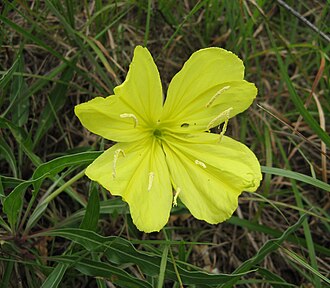
Missouri evening primrose sprawls flat on the ground and opens flowers four inches across — enormous for a plant this size — that unfurl visibly over a few minutes at dusk, pale lemon and papery, and fade by the following afternoon. Hawkmoths do the pollinating on the night shift, and the flowers are pale and heavily scented for exactly that reason. What follows is as good as the bloom: a large four-winged seedpod that dries to papery tan and holds through winter. It is built for hot limestone and gravel, with a deep taproot, and it will rot in a rich or irrigated bed faster than almost anything else in the catalog. It is a larval host for sphinx moths, whose caterpillars feed on the foliage the adults pollinate above. Leave it undisturbed, since the taproot makes it effectively unmovable after the first year.
- Family
- Onagraceae
- Type
- wildflower
- Lifespan
- perennial
- Height
- 0.75–1 ft
- Spacing
- 1–1.5 ft apart
- Light
- sun
- Soil moisture
- dry
- Soil pH
- alkaline
- Bloom
- April, May, June, July, August
- Bloom colors
- yellow
- Wildlife value
- hummingbirds, pollinators, larval host
- Caterpillar hosts
- ~16 butterfly & moth species
- Landscape uses
- border, groundcover, container, erosion control, naturalizing
- Native states
- AR, IL, KS, MO, NE, OK, TN, TX, UT
Related native plants
More Oenothera species
- Tufted Evening Primrose (Oenothera caespitosa)
- Pink Evening Primrose (Oenothera speciosa)
- Common Evening Primrose (Oenothera biennis)
- Hooker's Evening Primrose (Oenothera elata)
- Scarlet Beeblossom (Oenothera suffrutescens)
- Birdcage Evening Primrose (Oenothera deltoides)